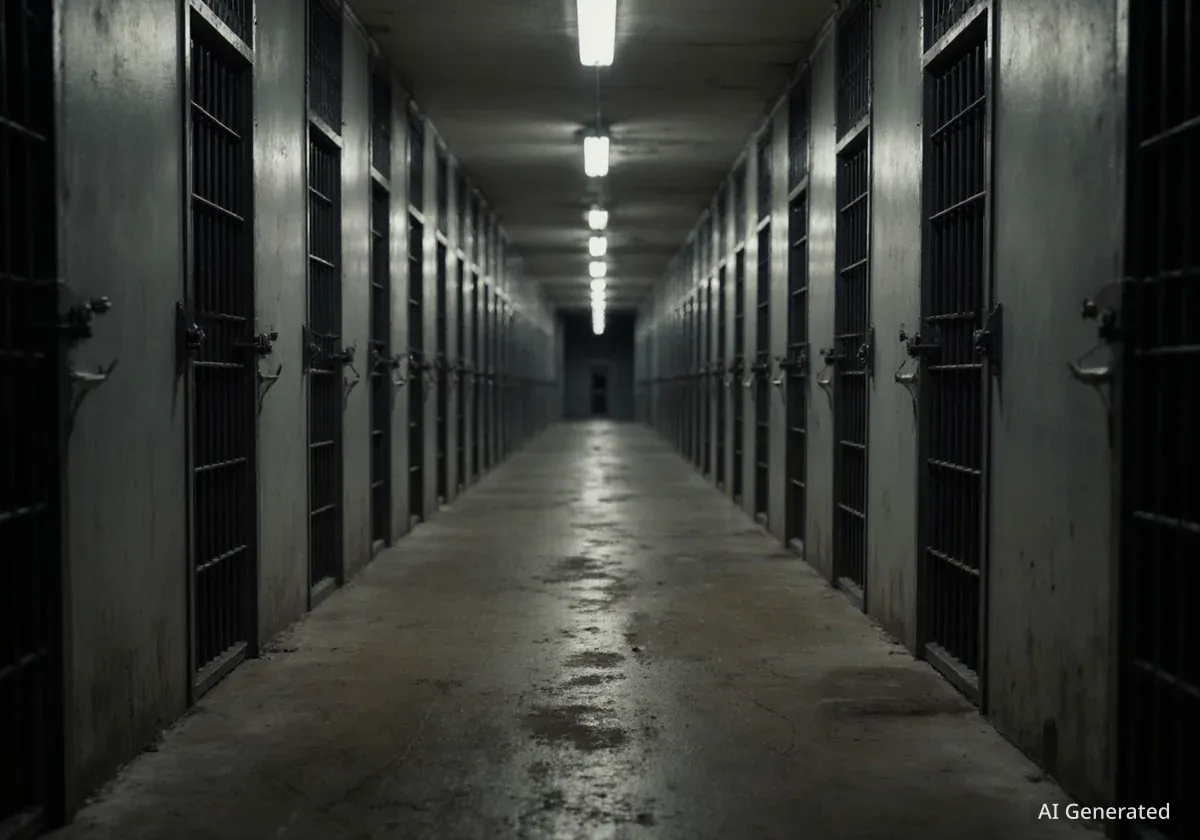


Swiss correctional facilities are experiencing significant overcrowding, with many cantonal prisons operating well beyond their official capacities. This situation is putting pressure on the justice system across the country, prompting discussions about expansion projects and alternative sentencing.
Key Takeaways
- Overall prison occupancy nationwide reached 94% in December 2023.
- Canton Vaud reported the highest occupancy rates, with Bois-Mermet at 166% and La Croisée at 143% in early 2024.
- Bern's regional prisons are at 124% capacity, while Zurich's Kreis 4 prison is at 102%.
- Several cantons, including Lucerne, Zug, Schwyz, and Thurgau, are planning expansions or new facilities.
- Authorities are exploring alternatives to incarceration, such as electronic monitoring and community service.
Rising Occupancy Rates Across Cantons
The issue of prison overcrowding is not new, but recent figures highlight a growing concern. Data from the Swiss Centre of Expertise in Prison and Probation (SKJV) shows that Swiss prisons were, on average, 94% full nationwide in December 2023. This figure indicates considerable strain on the system, according to the Conference of Cantonal Justice and Police Directors (KKJPD).
The canton of Bern saw an overall occupancy rate of 107% across its correctional facilities last year. Regional prisons within Bern, including those in Biel, Burgdorf, Moutier, and Thun, faced an even greater challenge, reaching 124% capacity.
Fact: Vaud Leads in Overcrowding
In early 2024, Vaud's Bois-Mermet prison in Lausanne recorded an occupancy of 166%, and La Croisée in Orbe was at 143%. These are some of the highest rates reported across Switzerland.
Overcapacity in Urban Centers
Zurich also grapples with high occupancy. The Kreis 4 prison is at 102% capacity, while the Pöschwies facility operates at 95%. Geneva’s Champ-Dollon prison has a long-standing issue of chronic overcrowding, currently standing at 122%.
Basel-Landschaft's facilities are at 95% for pre-trial detention and 107% for penal enforcement. Basel-Stadt, however, reports its prisons are well-utilized but not over capacity. The Waaghof pre-trial prison is at 73%, below its 2023 average of 83%. The Bässlergut facility is at 94%, consistent with its 2023 average of 90%.
Planned Expansions and Modernizations
In response to the growing demand for prison places, several cantons are moving forward with expansion and modernization projects. These initiatives aim to increase capacity and improve conditions within the correctional system.
Context: Long-Term Challenge
The increasing occupancy rates are not a sudden development. The SKJV notes that prison populations have been rising for several years. Authorities emphasize that this pressure does not signify a general system failure, but rather a need for ongoing adjustments and counter-measures.
Central Switzerland's Plans
Lucerne's Justice and Security Department acknowledges the strained situation. The Grosshof correctional facility in Kriens was at 98.4% capacity in 2023. To address this, Lucerne plans to renovate and expand the Wauwilermoos facility by 2034.
- The Bostadel correctional facility in Menzingen, Zug, will see its capacity increased between 2027 and 2029.
- Schwyz also plans to expand its cantonal prison in Biberbrugg.
These projects are crucial for managing the current and projected inmate populations. They represent significant investments in the country's justice infrastructure.
Challenges in Eastern and Western Switzerland
The eastern and western regions of Switzerland also report high prison occupancy. The closed section of Graubünden's Cazis Tignez correctional facility is currently at 95.3% capacity.
Thurgau's cantonal prison in Frauenfeld was at 104% capacity at the end of 2023. In St. Gallen, the Altstätten regional prison reached 114%, and the Gmünden prison in Teufen, Appenzell Ausserrhoden, was at 100%. All three cantons have announced expansion plans.
"The pressure on the system is real. We are seeing a steady increase in demand for prison places, necessitating both immediate action and long-term strategic planning."
Neuchâtel's Bellevue correctional facility in Gorgier operates at an average of 95-100% capacity. The La Promenade detention center in La Chaux-de-Fonds is between 85% and 95%.
Jura and Valais Also Affected
The Jura canton reports similar figures, with Delémont prison at 93% and Porrentruy prison at 89%. Porrentruy prison, which faced criticism from the National Commission for the Prevention of Torture for unacceptable conditions, is scheduled to close in the second half of 2026. The renovated Moutier prison will offer additional places upon reopening.
Valais authorities state that only the Sion pre-trial detention center is currently overpopulated. The canton intends to construct a new closed educational center in Pramont and a facility for therapeutic measures.
Exploring Alternatives to Incarceration
Beyond building new facilities, authorities are also examining alternative measures to reduce prison populations. These alternatives can help manage caseloads and provide more rehabilitative options for offenders.
Vaud is focusing on the long-term construction of a new prison in Orbe. However, the canton is also exploring options like electronic ankle tags and community service as alternatives to traditional imprisonment. These methods can reduce the burden on correctional facilities while still ensuring accountability.
Geneva is actively searching for land to build a new prison. This initiative reflects a direct response to persistent overcrowding at Champ-Dollon.
Fribourg also plans to expand its Bellechasse correctional facility, which has experienced partial 100% occupancy. In early February, 32 inmates at Bellechasse protested their detention conditions for nearly three hours, highlighting the urgent need for improvements.
In Ticino, correctional facilities show an average occupancy rate of 95%, according to the SKJV. This indicates a consistent, high level of utilization throughout the canton.
The multifaceted approach, combining new infrastructure with alternative sentencing, aims to create a more sustainable and humane justice system for Switzerland.