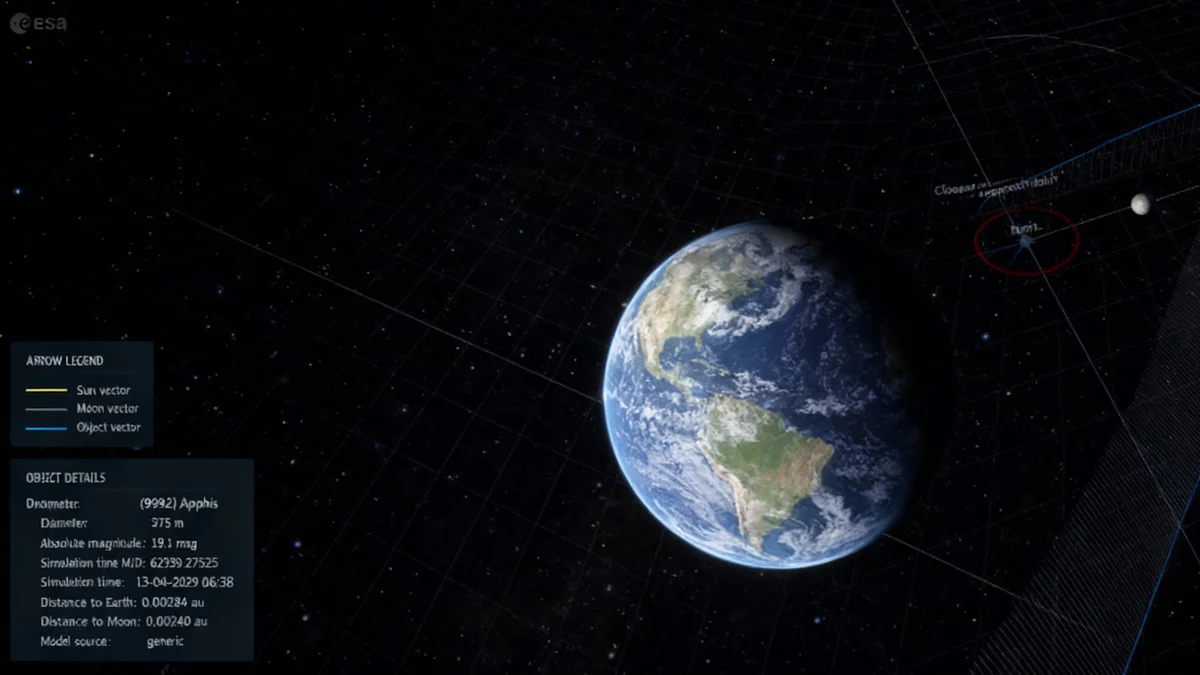


Scientists from the University of Bern are preparing to observe asteroid Apophis as it makes an exceptionally close approach to Earth in 2029. Researchers will use a specialized high-resolution camera to study how Earth's gravity affects the asteroid. This mission aims to gather crucial data for planetary defense strategies.
Key Takeaways
- Asteroid Apophis will pass Earth at a distance of 32,000 kilometers on April 13, 2029.
- The University of Bern is contributing a specialized camera, Chances, to the Ramses mission.
- Chances will capture detailed images to detect subtle deformations caused by Earth's gravity.
- The mission provides unique insights into asteroid behavior and helps develop deflection strategies.
Unprecedented Close Encounter with Apophis
The asteroid 99942 Apophis is set to pass Earth at an incredibly close distance of just 32,000 kilometers on April 13, 2029. This event is rare and offers a unique opportunity for scientific observation. For context, this distance is closer than some geostationary communication satellites orbiting our planet.
This close flyby is a central focus of the Rapid Apophis Mission for Space Safety (Ramses). The European Space Agency (ESA) and the Japanese Aerospace Exploration Agency (Jaxa) are jointly leading this international effort. The mission seeks to understand the physical changes an asteroid undergoes when subjected to significant gravitational forces.
Did You Know?
Apophis is estimated to be about 340 meters (1,115 feet) across. Its close approach in 2029 was initially a concern for a potential impact, but further calculations ruled out a collision for at least the next 100 years.
Bern's Contribution: The Chances Camera
The University of Bern plays a significant role in the Ramses mission. It is contributing a state-of-the-art camera system called Chances, an acronym for Colour High-resolution Apophis Narrowangle CamEra System. This instrument is designed to provide highly detailed observations of Apophis's surface and structure.
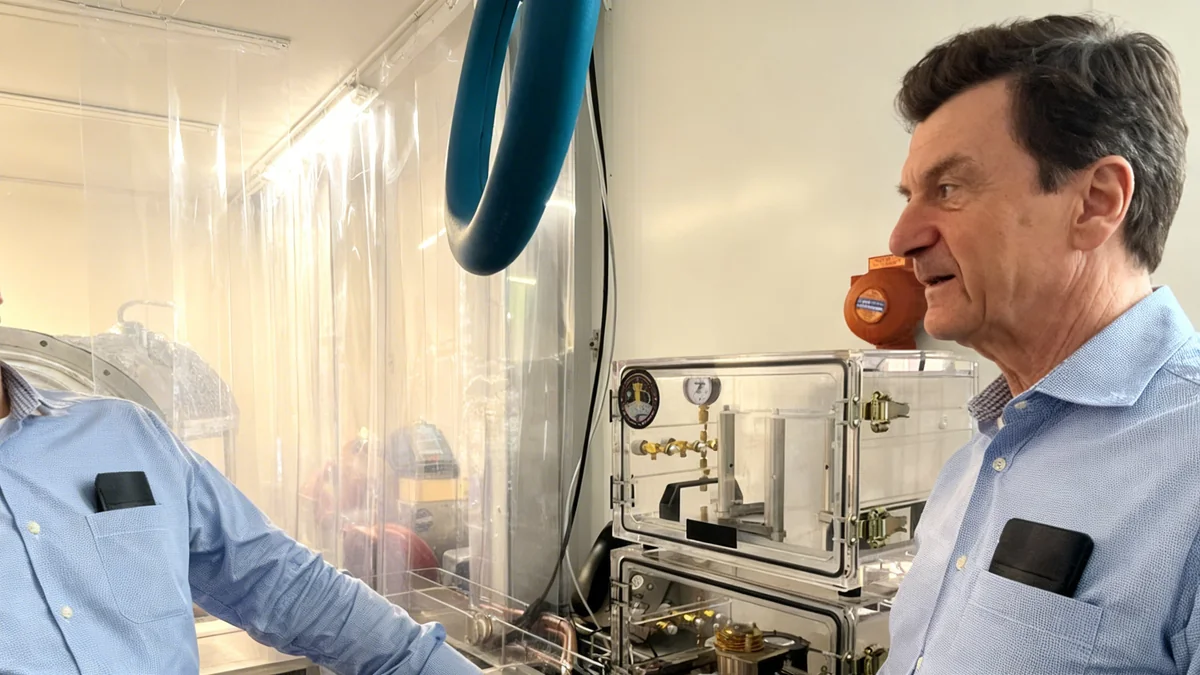
Antoine Pommerol leads the development of the Chances camera at the University of Bern's Physics Institute. He emphasized the camera's capabilities.
"Our instrument will make detailed images of Apophis's surface and be able to detect subtle changes caused by Earth's gravitational pull," Pommerol stated.
The camera's high resolution is critical. It will allow scientists to observe minute details that would otherwise be impossible to detect from Earth. This includes changes in the asteroid's shape and surface features.
Studying Gravitational Effects
When Apophis passes so close to Earth, our planet's strong gravitational field will exert significant tidal forces on the asteroid. Scientists predict these forces will cause several observable effects. The asteroid's shape could slightly deform, and its rotation might change. These are key areas of study for the Chances camera.
Additionally, the gravitational stress could trigger small landslides on Apophis's surface. Such events might expose material from the asteroid's interior that has never been seen before. This would offer valuable clues about its composition and internal structure.
Background on Tidal Forces
Tidal forces are the differential gravitational forces exerted by a celestial body on different parts of another body. On Earth, these forces are responsible for ocean tides, caused by the Moon's gravity. In space, they can deform or even break apart smaller objects like asteroids.
Advancing Planetary Defense
Beyond its scientific value, the Ramses mission has a critical practical application: planetary defense. The data collected from Apophis will be instrumental in developing strategies to protect Earth from future asteroid impacts. Understanding how an asteroid reacts to gravitational forces is vital for any potential deflection mission.
Martin Jutzi, also from the University of Bern's Physics Institute, highlighted this aspect.
"The data gained will help develop strategies for deflecting asteroids and thus ensure the safety of our planet," Jutzi explained. "Apophis's close flyby offers a unique opportunity to study the effects of Earth's tidal forces on an asteroid."
These insights are fundamental for designing effective asteroid deflection concepts. They will inform how engineers might alter an asteroid's trajectory if it ever posed a threat to Earth. The mission is a proactive step in safeguarding our planet against cosmic dangers.
The collaboration between international space agencies and research institutions like the University of Bern underscores the global effort required for planetary defense. The 2029 flyby of Apophis represents a significant moment for space science and Earth's long-term security.