
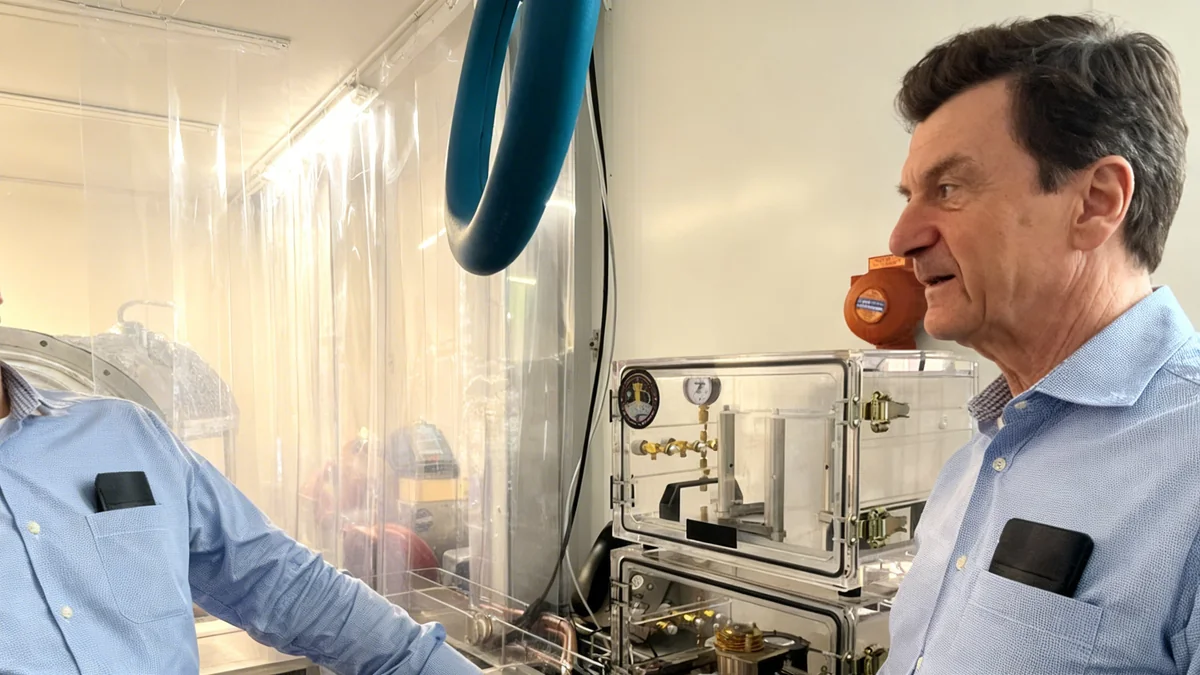


Two leading researchers from the University of Bern, Wanda Kukulski and Paola Luciani, have each secured highly coveted ERC Synergy Grants. These prestigious European Union awards will fund groundbreaking projects in cell biology and drug delivery, fostering international collaboration over the next six years.
Key Takeaways
- University of Bern researchers Wanda Kukulski and Paola Luciani received ERC Synergy Grants.
- These grants, valued at up to 10 million Euros, support collaborative research for six years.
- Switzerland's researchers are now eligible again for ERC funding after a 2021 exclusion.
- Kukulski's project, MitoContact, explores mitochondrial interactions within cells.
- Luciani's project, CARAMEL, develops new drug delivery methods to bypass cell membranes.
Switzerland Rejoins Horizon Europe Funding
The ERC Synergy Grants are among the most prestigious research grants in Europe. They are supported by Horizon Europe, the European Union’s research and innovation program. For the first time since 2021, Swiss researchers were eligible to apply for this highly competitive funding. This eligibility marks a significant step forward in negotiations between Switzerland and the EU, with the official association of Switzerland with Horizon Europe expected by the end of the year.
This re-inclusion is a major boost for Swiss scientific institutions. The opportunity to participate in such high-level European research initiatives allows for greater collaboration and resource sharing across the continent. It also reinforces Switzerland's position as a key player in global scientific advancement.
Grant Facts
- Funding: Up to 10 million Euros per project.
- Duration: Six years of research support.
- Success Rate: 66 projects funded out of 712 applications (approximately 9%).
- Gender Diversity: 25% of funded project researchers are women.
MitoContact Project: Unlocking Cell Secrets
Professor Dr. Wanda Kukulski, from the Institute of Biochemistry and Molecular Medicine at the University of Bern, leads the MitoContact project. Her team focuses on mitochondria, often called the 'powerhouses of the cell.' However, mitochondria perform many more functions, including metabolism and signaling pathways. Kukulski's research specifically investigates how mitochondria interact with other cell organelles at crucial points called membrane contact sites.
These contact sites are vital for exchanging molecules and signals, processes that underpin cellular function. "The goal of the MitoContact project is to gain a deep understanding of the function, architecture, and dynamics of these contact sites," Kukulski explained. Understanding these interactions is essential for comprehending both healthy and diseased cellular states.
"By combining state-of-the-art technologies such as chemical biology, live fluorescence microscopy, and 3D electron microscopy, we can precisely localize and visualize molecular events that underpin the functionality of our cells."
Advanced Imaging Techniques
The MitoContact project will employ cutting-edge technologies. Advanced live fluorescence imaging and 3D electron microscopy will combine with chemical-biological tools. This allows researchers to identify molecular-level events with unprecedented precision. Kukulski's group brings expertise in correlative light and electron microscopy, a technique already used to visualize membrane contact sites at high resolution.
This collaborative effort involves laboratories from EPFL (Switzerland) and the MPI for Medical Research in Heidelberg (Germany). The comprehensive approach aims to fill critical knowledge gaps about molecular mechanisms. This new understanding could pave the way for developing novel therapeutic strategies for various diseases.
What are Mitochondria?
Mitochondria are complex organelles within cells. Beyond energy production, they play roles in cellular metabolism, signaling, and programmed cell death. They interact constantly with other parts of the cell through specialized physical interfaces called membrane contact sites, which are crucial for exchanging materials and information.
CARAMEL Project: Revolutionizing Drug Delivery
Professor Dr. Paola Luciani, from the Department of Chemistry, Biochemistry, and Pharmaceutical Sciences at the University of Bern, is leading the CARAMEL project. Her research aims to develop innovative solutions in drug delivery. Many promising therapeutic molecules, such as peptides and proteins, cannot reach their targets inside cells because they cannot cross the protective cell membrane.
"Many promising therapeutic molecules are not used because they cannot penetrate the protective cell membrane and thus do not enter the cell interior," Luciani stated. The CARAMEL project challenges conventional drug design principles. It proposes a fundamentally new mechanism for cellular transport, potentially revolutionizing how medicines are delivered.
"With the CARAMEL project, we can combine our expertise to develop a fundamentally new mechanism for cellular transport. This could revolutionize our understanding of membrane transport mechanisms and enable a new form of therapies."
New Transport Mechanism for Therapies
The CARAMEL project is considered groundbreaking because it questions all previous assumptions about how a molecular transporter should look and function. By deciphering this new biological pathway, the research has the potential to shake up the foundations of membrane transport research. The 10 million Euro grant will enable a systematic investigation of this novel transport phenomenon.
The ultimate goal is to validate its potential for therapeutic applications. This includes providing proof-of-principle for future medical developments, such as innovative strategies for cancer treatment. The CARAMEL team includes four principal investigators from leading European universities. These include researchers from Spain, Germany, and Switzerland, highlighting the international scope of the project.
University of Bern's Research Excellence
Hugues Abriel, Vice-Rector for Research and Innovation at the University of Bern, expressed his enthusiasm for these achievements. "We are extremely pleased that two top researchers from the University of Bern are conducting significant synergy projects with international teams as part of the ERC Synergy Grants," Abriel said.
He added that this success sends an important and encouraging signal. "This also sends an important and encouraging signal for all junior researchers in Bern and beyond," Abriel concluded. The recognition underscores the University of Bern's commitment to cutting-edge research and its ability to attract top scientific talent.
- The ERC Synergy Grants foster collaborative research across Europe.
- Projects aim to advance fundamental understanding of cell biology and drug delivery.
- The grants highlight the importance of international scientific cooperation.